AURORA: The threshold into consciousness, reality, illusion, and the human condition.
It may seem unusual, in a time like this, to begin with a book.
The culture of the moment favors speed, fragments, clips, summaries, reaction, positioning, and accelerated opinion. Attention is under pressure. Meaning is compressed. Language is often used to signal belonging faster than to deepen understanding. In such a climate, the act of reading slowly – really reading – becomes almost countercultural.
And yet this is precisely one reason why AURORA matters now.
We are living at a turning point shaped by intensifying uncertainty, technological acceleration, contested truth, and rising pressure on human attention and trust. Across work, public life, and private life, there is a growing experience that inherited interpretive frameworks no longer hold as firmly as they once did. People are surrounded by explanations, but not necessarily by meaning. They are surrounded by signals, but not necessarily by orientation.
AURORA enters precisely here.
It is not simply a novel in the conventional sense. It is not designed as quick entertainment, nor as a system of doctrine. It is a threshold text. A symbolic and non-linear work concerned with consciousness, illusion, awakening, remembrance, and the human condition.
Why does that matter now?
Because one of the deepest crises of our time is not merely political, technological, economic, or cultural. It is perceptual.
We do not only suffer from false information. We also suffer from narrowed perception.
We do not only suffer from bad systems. We also suffer from the stories through which those systems are normalized.
We do not only suffer from confusion about the world. We also suffer from confusion about the self that is looking at the world.
AURORA matters because it enters that deeper layer.
It asks what kind of world is produced when consciousness forgets itself. It asks what distortion does to human experience.It asks what becomes visible when the structures of ordinary reality begin to loosen. And it asks what happens when a person can no longer fully return to the old way of seeing.
That is why I would not position AURORA merely as “Book One.” of the Morning Star Trilogy.
It is better understood as the first threshold.
A threshold into the wider trilogy. A threshold into the wider work. A threshold into a different relationship with reading itself.
For some readers, AURORA will matter because they are already asking metaphysical questions.
For others, it will matter for a different reason. It names something they have long sensed but have never seen articulated clearly: that the world we usually inhabit is structured not only by facts and events, but also by layers of interpretation, concealment, adaptation, forgetting, and inherited distortion.
AURORA does not flatten that complexity into a slogan. It works with it symbolically, atmospherically, and existentially.
That is part of why a book still matters now.
A book can hold a wider field than a post. A book can contain tension without rushing to resolve it. A book can work beneath argument. A book can alter a person not only through ideas, but through form, rhythm, pattern, resonance, and recognition.
And in a time of fractured attention, that is not a luxury. It is a serious cultural function.
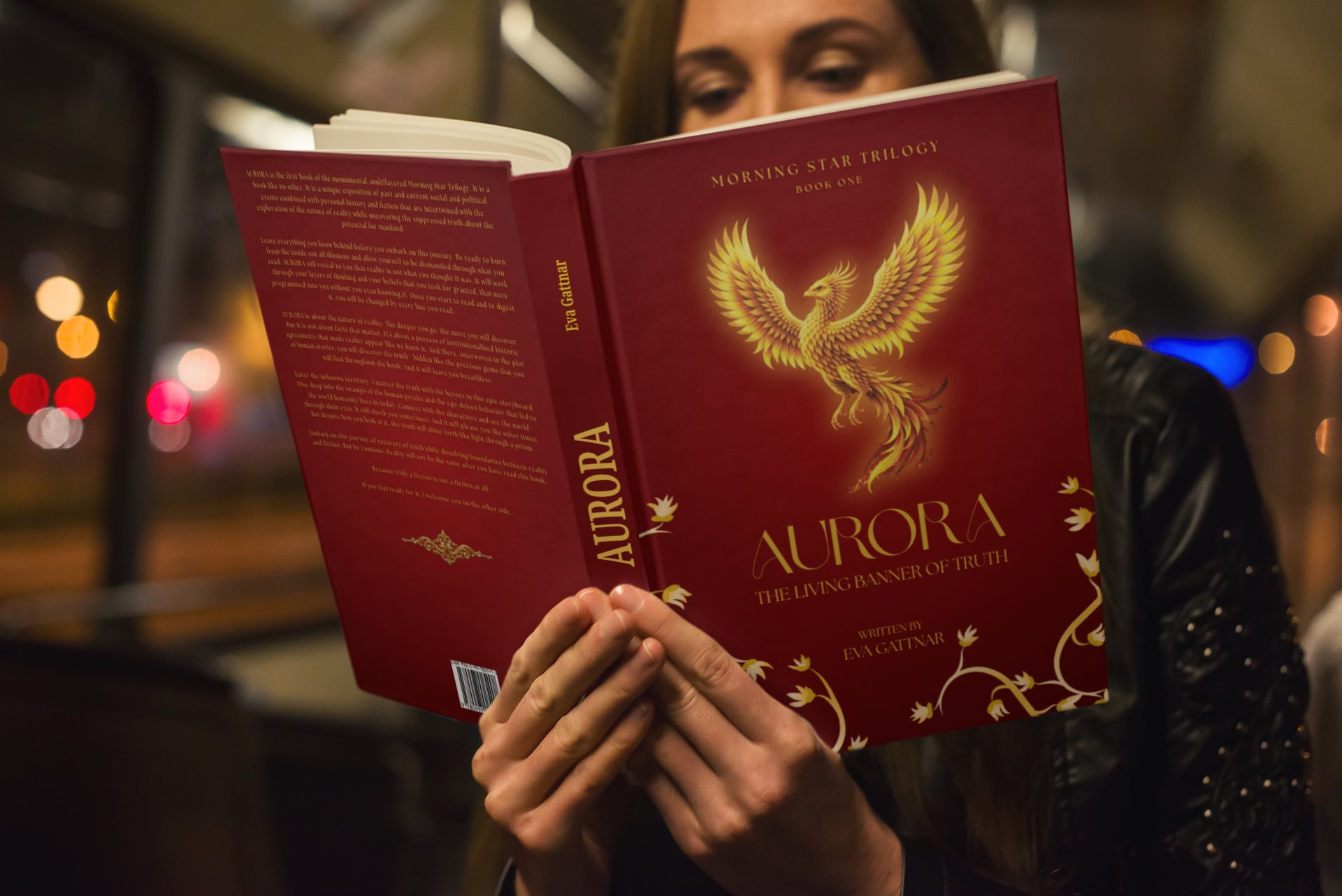
AURORA is also important because it belongs to a larger architecture. It is the opening movement of the Morning Star Trilogy, followed by PHOENIX and MADONNA, with ALEPH as its companion codex. Together, these works form the literary core of a broader inquiry into consciousness, reality, freedom, remembrance, and transformation. But AURORA is where the first light appears.
That makes this moment especially important.
As the book is available for pre-order and moves toward its official publication date of May 1, it marks not only a publication event, but the opening of the literary threshold into the whole body of work. Its companion intensive Riding the Matrix™ takes place May 30–31 online. The early bird rate ends May 1.
Why now?
Because many people already feel that the old frameworks are thinning. Because many people already sense that the visible world is not the whole world. Because many people are searching not merely for more content, but for language equal to what they are living.
AURORA is written for that threshold.
Not for passive consumption. Not for fashionable spirituality. Not for decorative insight.
But for those willing to read in a way that changes the reader.
To begin with AURORA is not only to begin with a story. It is to begin with a different way of encountering reality.
And in a time when so much language is spent in reaction, strategy, distraction, and noise, that kind of beginning matters more than it may first appear.